Tuesday, February 24, 2009

A Walk in Gallup Park and first lesson in Digiscoping

I have recently developed an interest in the Digiscoping technique. Michigander Jerry Jourdan's Blog or Wisconsin Based Mike McDowell for instance, shows some miraculous (depending of my mood, I sometimes found them disgustingly sharp and perfect) avian pictures, just by the use of a (high end) scope, a tiny point and (good) point & shoot camera, and a generally hand made adaptor. All my tries so far had been exclusively hand held (no adaptor, no shutter release), and the results were ranging from extremely bad to barely mediocre. Facing the reality of tough economic times, and without having $5,000 to spend into a DSLR camera equipped with a disproportionate appendix (I am not not sure if I would like to carry one of these things anyway), I thought this technique was certainly worth exploring.

So armed with various handsaw and other curiously inefficient tools, I managed to create a decent adaptor from a plastic cup. The results can be certainly greatly improved by using power tools, but I guess I did it only to give me a taste of the technique.
The first results are shown below. In fact the first pictures I really took were a box of vitamins on the other side of the yard, but, I choose to show birds instead. I quickly found out that the mode "quick burst" of my tiny camera had the great advantage of taking 10 frames a second, thus increasing statistically the chances to obtain one decent shot. On the down side, though, this mode "push" automatically the camera into the high ISOs (800) which theoretically should increase the graininess of the shot. In addition, the camera reduces the size of the picture to only 2.3 mega pixels, instead of the 8 or 5. But I thought it was a good starting point.

American Goldfinch, digiscoped


Pine Siskin, digiscoped


Female Downy Woodpecker, digiscoped

Results were not too bad for a first try, but I had to try on further birds.

So I went to Gallup park last Sunday, trying to experiment on the increasing number of waterfowl present on the Huron River. A detail of importance, the temperature was 15F (-8C), and the windchill around 0F (-17C). I usually dont care too much about windchill, because a good winter coat and gloves offer good protection against the wind, so windchill does not really count


Biking Path in Gallup Park


I first spotted a group of Common Mergansers swimming at about 150 feet away. I thought it was a good starting point. Ok, here is my adaptor, I set up my scope and try to attach my camera to the adaptor. Mmm not easy with these big gloves. Ok I'll take them off. Ok, now I try to set up the camera to the proper mode, despite the velcro bands that partially cover the buttons. MMM not easy.


I take a few shots of the Mergansers. Left hand fingers on the focus knob, right hand on the camera. Boy, it is cold here


digiscoped Common Merganser defending his freedom of speech


Male Hooded Merganser, digiscoped

After 2-3 minutes, my fingers are numb, and I have to reluctantly admit my defeat. I quickly come back to my car and tried to warm up my fingers. Slowly, Painfully, sensation comes back and I am ready for another walk. This time I decided to only take my binoculars and the camera.

Despite the cold, there was a feeling that spring was not too far away. Numerous chikadees were singing, as well as several Tufted Titmice and Cardinals. Along the sidewalk I spot several bluebirds.

As I walk leisurely on the path, I can not help but thinking about the spring that will come soon. Already the first redwinged blackbirds have been spotted in the county, and a few tree swallows were found on the shore of lake Erie. In a bit more than a month, we should be able to see the first warblers, probably a yellow rumped.

And maybe, more chances to train for digiscoping in warmer weather!!!!!


Bluebird, digibinned


Monday, February 23, 2009

Great Lakes Piping Plover in Florida

During our last trip in Florida, I noticed a banded Piping Plover on Bunch Beach, Florida. I somehow managed to digibins a few pictures, and, unsure of the color of some of the bands, decided to directly send the (admittedly bad) pictures to the graduate student who is part of the research of the great lakes piping plovers.


Here is his/her answer


Hi Laurent,This is definitely a Great Lakes bird. It was actually a captive-reared bird from the 2008 field season. The green band is actually a triple split band of green/orange/green that we use for the adult captive-reared birds. Thanks so much for your sighting information!Kelsi XXX (plover undergraduate student)
Wow, so this bird is from Michigan after all!!! (I was told the captive reared birds are raised in Michigan). I wish him good luck, and hope to see this little guy again in Sleeping Bear Dunes National Lakeshore next summer!

Tuesday, January 27, 2009

Winter birding at Lake Erie Metropark


As liquid water as pretty much disappeared from Washtenaw county, except a little stretch of water at the beach of the arb, Diane offered me last Saturday the opportunity to go birding at Lake Erie Metropark, as she has another cat show at Allen Park. Saturday was a magnificent - and frigid - day, one of these days where Mr Winter shines, and when you don't regret at all the cloudy and rainy winters of the north of France. Oh boy, I love winter birding, for 3 reasons :


- First, you don't have to wake up at 5 in the morning and rush out to Starbucks (or, depending on the economic situation, Mc Donald's) and rush out to Crane Creek or Pointe Pelee to be there at dawn....So winter birding means waking up at 9 AM, drinking a warm coffee in the sofa and watching the Juncos and chikadees having breakfeast with the lone Pine Siskin that we have currently in our garden. Then, only after you have watched the news and drinked your second cup of coffee, you can fix some french toasts, and eat them while having your third cup of coffee, and start to think about how many layers you will wear today

- Second, for some strange reason , you have the whole park for yourself, most of the time. I mean, 1000 acres of marshland and lakes just for you and your binoculars. Which means you will never meet anybody who will tell you " what a shame you came so late, this morning we had an Iceland gull on the beach". Of course, you will never meet anybody to brag out about the very nice bird you just saw, either

- Third, it is usually so cold that you never regret to have a bit more time to do more birding.

As I arrived, the Parc Ranger told me : " you should probably go on the south side, on the north side, there is only mute swans". There was, effectively, a few mute swans. hundreds or even thousands of them, mixed with Tundra and Trumpeter's. There were also thousands of Canevasbacks (6,000?), hundreds of common mergansers and redheads, as well as all the commoners of michigan. What a show!!!!!! On the raptor side, a Northern Harrier was spotted, and a dozen Bald Eagles (half of them being juvenile) were seen flying over the open water

Lake Erie metropark Lakeshore


Mute Swans and Tundra Swan, and Canvasback, digiscoped


Seeking a respite from the cold wind, I later went birding in the woods, close from the Hawk watching site. Here a few song birds, such as Robins, a lone Brown Creeper, White Throated Sparrows. But the stars of the day were a large flock of Redpolls (my first this winter). Among them, I noticed a much paler bird, making me think about the You-know-who.....But this tiny fellow did not want to be taken in picture, probably thinking that he deserved better than a digibinned picture. His darker friends were more cooperative...


American Robin, digibinned

Common Redpoll, digibinned


The Complete List was :


Location: Lake Erie MetroparkObservation date: 1/24/09Notes: 10F, clear skyNumber of species: 27 Canada Goose 0Mute Swan 3000Tundra Swan 2000American Black Duck 12Mallard 24Canvasback 6000Redhead 200Ring-necked Duck 12Lesser Scaup 12Bufflehead 24Common Goldeneye 1Hooded Merganser 2Common Merganser 300Ruddy Duck 12Great Blue Heron 6Bald Eagle 12Northern Harrier 2American Coot 2000Ring-billed Gull 6Herring Gull 1Mourning Dove 12Downy Woodpecker 1American Crow 2Black-capped Chickadee 12Brown Creeper 1American Robin 12White-throated Sparrow 4Common Redpoll 30This report was generated automatically by eBird v2(http://ebird.org/)


Monday, January 26, 2009

Work place bird #9

I gave up a few months ago to the idea to bird during my lunch time. I mean, ok there is a couple of peregrine falcons on the capitol, but my work list is still well below the symbolic threshold of 10. Last Wednesday, I went out to grab a coffee at the local coffeeshop, when I noticed freshly fallen cones at the feet of a couple of white pines we have at our building entrance. These white pines apparently grow well in the atmosphere of concrete and cigarette smoke (possibly because of the high concentration of carbon dioxide?).


Who is doing this racket? I listen carefully. No call notes, but the characteristic noise of cones being open....
8 White Winged Crossbills !!!!!!!!!!!!!!

Thursday, January 22, 2009

Cold is a relative thing

Just a joke somebody send me


COLD IS A RELATIVE THING. .

65 above zero:
Floridians turn on the heat.
People in Michigan plant gardens.

60 above zero (15 Celsius)
Californians shiver uncontrollably.
People in Michigan sunbathe.

50 above zero:
Italian & English cars won't start.
People in Michigan drive with the windows down..

40 above zero:
Georgians don coats, thermal underwear, gloves, wool hats.
People in Michigan throw on a flannel shirt.

35 above zero (2 Celsius)
New York landlords finally turn up the heat.
People in Michigan have the last cookout before it gets cold.

20 above Zero
People in Miami all die.
Michiganders close the windows.

Zero (-17 Celsius)
Californians fly away to Mexico .
People in Michigan get out their winter coats.


10 below zero (-23 Celsius)
Hollywood disintegrates.
The Girl Scouts in Michigan are selling cookies door to door.


20 below zero:
Washington DC runs out of hot air.
People in Michigan let the dogs sleep indoors.

30 below zero:
Santa Claus abandons the North Pole.
Michiganders get upset because they can't start the Snow-mobile.

40 below zero ):
ALL atomic motion stops .
People in Michigan start saying...'Cold enough fer ya?'

50 below zero:
Hell freezes over.
Michigan public schools will open 2 hours late

Tuesday, January 13, 2009

Florida trip 3/3


I am writting the last part of this trip report, as the temperature is currently frigid here in Michigan! (temperature in Celsius)


Ding Darling Wildlife Trail, Sanibel Island

Ding Darling Wildlife Trail is a a wonderfull 5 mile road (cars, walkers and bike users are sharing this road at very low speed) crossing the Ding Darling Refuge, a rare conservation gem (and birding hotspot) of south Florida. Birds are just impressive (shear number of birds, as well as species variety). Most of the waders were found (including reddish egret, spoonbills, Yellow Crowned Night Herons) as well as lesser and yellowlegs (surprisingly enough, we did not find these birds in Fort Myers or Bunch Beach). The big stars of the day were obviously the white pelicans, hard to find outside of this area. Another very interesting sighting was 2 Ospreys harrassing a Bald Eagle, close from the visitor center. 2 White Winged Doves were also seen on a Sanibel Island Road.


White Pelicans (Pelican d'Amerique), digiscoped

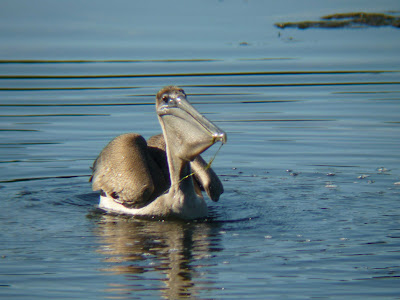
Brown Pelican (Pelican Brun), digibinned


Lover's Key State Park


Ok, this park is a wonderfull beach, and was only a mile or two from the hotel. Beside a few hundred sanderlins, a little blue heron and a nest of Osprey, there was not much to be seen the day we went (maybe because we spend most of our time relaxing and reading on the sand). We had a great view of an Osprey nest, though, so I did a little bit of digiscoping experiments


Osprey nest, digiscoped


Obviously, there is room for improvement! In particular, I absolutly need an adaptor between camera and scope (I am working on it right now)


Estero Pass Preserve


This park is located on the Fort Meyers Key itself, and is basically the last remaining stand of Mangroves of the key. We found this preserve extremely interesting, as we were able to find some good passerines, specially on the south east part of the park. Prairie (lifer!) and Yellowthroated warblers (1 each), Mockinbird, Eastern Phoebe and Blue Headed Vireo, as well as dozen of Blue Grey Gnacatchers were seen, a nice change from the gulls and shorebirds of the week. A flyover of Magnificent Frigatbird and a Yellow-bellied Sapsucker was a nice add to the list


Mockingbird, digibinned


Eastern Phoebe (Moucherolle Phebi), digibinned

6 mile cypress in Fort Myers

This was the last birding site we visited, just before taking the plane back to the frozen tundra of michigan. Great park with about 2 mile of boardwalks, but birds were not very active in the middle of the day. We had great views of several anhingas, though, and also found a few passerines (Great Crested Flycatcher, Palm Warblers). A wonderfull experience was to see a male Anhinga swimming underwater. Is it cool or what?


White Ibis (Ibis Blanc), p&S camera

On the way to the airport, we spotted (at last!) our final birds for the trip, Loggerhead Shrikes (many of them on electric wires) and Cattle Egrets


TRIP LIST

Mottled Duck Canard brun
Red-breasted Merganser Harle huppé
Pied-billed Grebe Grèbe à bec bigarré
American White Pelican Pélican d'Amérique
Brown Pelican Pélican brun
Double-crested Cormorant Cormoran à aigrettes
Anhinga Anhinga d'Amérique
Magnificent Frigatebird Frégate superbe
Great Blue Heron Grand Héron
Great Egret Grande Aigrette
Snowy Egret Aigrette neigeuse
Little Blue Heron Aigrette bleue
Tricolored Heron Aigrette tricolore
Reddish Egret Aigrette roussâtre
Cattle Egret Héron garde-boeufs
Green Heron Héron vert
Yellow-crowned Night-Heron Bihoreau violacé
White Ibis Ibis blanc
Roseate Spoonbill Spatule rosée
Wood Stork Tantale d'Amérique
Black Vulture Urubu noir
Turkey Vulture Urubu à tête rouge
Osprey Balbuzard pêcheur
Bald Eagle Pygargue à tête blanche
Cooper's Hawk Épervier de Cooper
Red-shouldered Hawk Buse à épaulettes
American Kestrel Crécerelle d'Amérique
Black-bellied Plover Pluvier argenté
Snowy Plover Pluvier à collier interrompu
Wilson's Plover Pluvier de Wilson
Semipalmated Plover Pluvier semipalmé
Piping Plover Pluvier siffleur
Killdeer Pluvier kildir
American Oystercatcher Huîtrier d'Amérique
Spotted Sandpiper Chevalier grivelé
Greater Yellowlegs Grand Chevalier
Willet Chevalier semipalmé
Lesser Yellowlegs Petit Chevalier
Long-billed Curlew Courlis à long bec
Ruddy Turnstone Tournepierre à collier
Sanderling Bécasseau sanderling
Western Sandpiper Bécasseau d'Alaska
Least Sandpiper Bécasseau minuscule
Dunlin Bécasseau variable
Laughing Gull Mouette atricille
Ring-billed Gull Goéland à bec cerclé
Royal Tern Sterne royale
Black Skimmer Bec-en-ciseaux noir
Eurasian Collared-Dove Tourterelle turque
White-winged Dove Tourterelle à ailes blanches
Mourning Dove Tourterelle triste
Burrowing Owl Chevêche des terriers
Belted Kingfisher Martin-pêcheur d'Amérique
Red-bellied Woodpecker Pic à ventre roux
Yellow-bellied Sapsucker Pic maculé
Downy Woodpecker Pic mineur
Northern Flicker Pic flamboyant
Pileated Woodpecker Grand Pic
Eastern Phoebe Moucherolle phébi
Great Crested Flycatcher Tyran huppé
Loggerhead Shrike Pie-grièche migratrice
White-eyed Vireo Viréo aux yeux blancs
Blue-headed Vireo Viréo à tête bleue
Fish Crow Corneille de rivage
Tree Swallow Hirondelle bicolore
Carolina Wren Troglodyte de Caroline
Blue-gray Gnatcatcher Gobemoucheron gris-bleu
Gray Catbird Moqueur chat
Northern Mockingbird Moqueur polyglotte
Yellow-throated Warbler Paruline à gorge jaune
Pine Warbler Paruline des pins
Prairie Warbler Paruline des prés
Palm Warbler Paruline à couronne rousse
Black-and-white Warbler Paruline noir et blanc
Common Yellowthroat Paruline masquée
Northern Cardinal Cardinal rouge
Painted Bunting Passerin nonpareil
Boat-tailed Grackle Quiscale des marais


Friday, January 9, 2009

Florida trip 2/3 Estero Preserve : the six plovers beach

Fort Myers beach is a great place to spend some vacation. I mean what else can you hope for? Imagine. From the beach bar of the hotel, a mojito in hand, you can see on the right side of the beach a one mile strech of white sandy beach. On the left side, one of the best hotspot of Florida. A lagoon where shorebirds and waders feed at low tide, and roost at high tide. This beach is well known to be a reliable place for snowy and piping plovers, and sometimes marbled godwits, long-billed curlews and willets. Birds were also particularly tame, offering good opportunities for easy pictures.

In fact, I was able to find most of the waders, shorebirds and sea birds of our trip (one exception being the white pelican and the 2 species of yellowlegs, only seen during this trip at the Ding Darling Refuge) on this one mile strech of beach. I spotted in average one American Frigatebird every day, and one evening, had the good surprise to find a LONG-BILLED CURLEW (Courlis a long bec) (Why did I forget my camera on this day?), 50 feet from us!!!! I took a long time to check that this was not a Wimbrel (which would have been a lifer for us too!). But no mistake here, HUGE bill, Buffy underparts (almost orange), we had a curlew here. Altogether, we were able to found 6 species of plover (Snowy, Piping, Wilson, Semipalmated, Blackbellied and Killdeer). Western Sandpipers were also numerous, and a few Least Sandpipers were seen

All the common waders were also found (Yellow-Crowned Night Heron, Reddish Egret, Little Blue Heron, Spoonbills, White Ibis, etc). A few songbirds were also seen (Cardinals, Palm Warblers, Tree Swallows).

Thousands of Laughing Gulls were there of course, as well as hundreds of Royal and Sandwich Terns, and dozens of Brown Pelicans, Double Crested Cormorants and a few flyover of Anhingas. At one point I saw a bird that might have been a Gull Billed Tern (all white head, black bill), but I still have a doubt about my ID (not sure about the shape of the bill, so it might have been...something else).

Piping Plover (Pluvier Siffleur), digiscoped


American Oystercatchers (huitriers americains) and Willets (Chevaliers Semipalme) , digibinned


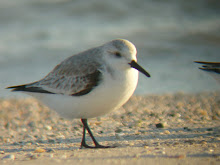
Sanderling (Becasseau Sanderling), Digibinned

Wilson's Plover (Pluvier de Wilson), digibinned


Snowy Plover (Pluvier a Collier Interrompu), digibinned


Semi palmated plover (Pluvier Semipalme), digibinned


Magnificent Frigatebird (Fregate Superbe), Digibinned


Roseate Spoonbill, digibinned