Friday, May 31, 2013
Birding Harrisville
Tuesday, December 4, 2012
The soaring DC cormorant Identification issue
May 2011. It is only 4pm, but we (Andy Dettling, Laurent Fournier, Jacco Gelderloos) have been up for about 14 hours, and biked and hiked for about 75 miles, smashing our own previous Washtenaw county (Michigan) bigby (=carbon free) record of 114 species. We enter Ann Arbor's Nichols Arboretum where dozen of people are sunbathing, enjoying the warm spring afternoon.
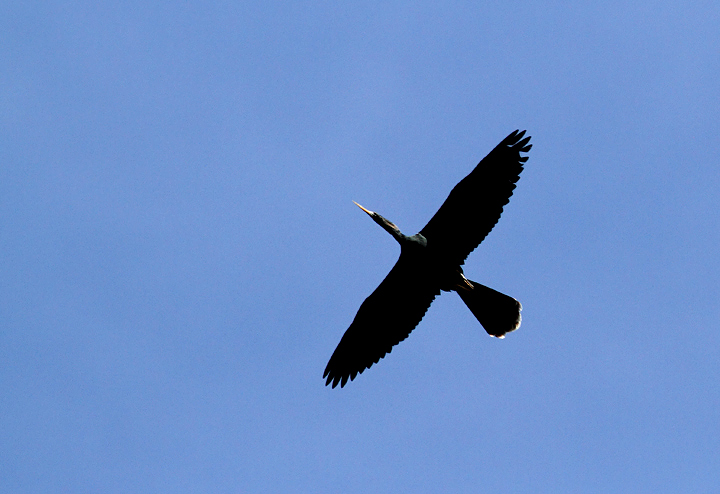
Suddenly, one of us notice something soaring in the blue sky. Black, long neck, long pointy wings, fanned out tail, soaring without a wingbeat and rising in a thermal next to a Turkey Vulture.
We look in silence at the bird for a few seconds, and finally, one of us states the obvious. Anhinga. Mega, mega bird for Michigan (this would have been the third state record for Michigan). Pictures were taken and later posted in local and Florida lists. Initially at least, the consensus was unanimous. The behaviour was fitting Anhiga extremely well.
Later, though,it appeared that something was not quite right about the ID. The fanned out tail, in particular, was a bit too short and proportions were not quite right.
For comparison purposes, here is an Anhiga's picture taken taken from the 10,000 birds gallery (photo : Corey Finger)
Caleb Putman, local lister and former member of the Michigan Rare Bird Commitee posted this comment on my flickr picture :
"I think it's a Cormorant. When they soar they often look very different from when they are flapping, and the shape begins to approach Anhinga. The tail looks proportionately longer, especially. Here is a very similar photo I took at Port Huron : www.flickr.com/photos/27846187@N07/5430008150 /
Later, local birding listserv owner Bruce Bowman compared the pictures with some Anhinga pictures found in field guides :
"My calculations are below. First, I determined the expected W/L ratios for Anhinga and Double-crested Cormorant using values from the Sibley field guide. Next I used The GIMP image editor to measure W and L in pixels for the four posted photos, one at Grove Street and the three at Flickr. These values and the associated W/L ratios are in the table below".
| Anhinga | DC Cormorant | Our bird | |
| W | 45" | 52" | 53.9 px |
| L | 35" | 33" | 31.5 px |
| W/L | 1.29 | 1.58" | 1.72 |
Suddenly, it became pretty clear that our initial identification was wrong and that we, in fact, witnessed a soaring DC cormorant. Our bird was simply too short.
Interestingly, 10,000 birds beat writter Jochen experienced a similar identification crisis the same location a few years earlier :
I later decided to dig a little deeper to explore the various forms of DC cormorant flight. Fact is, soaring DC Cormorants are not very well documented in the commonly available field guides.
In most birding field guides (Sibley, National Geographic are the ones I owned and checked), there is no mention of any potential confusion between soaring DC Cormorants and Anhingas. In the Cornell Lab Website, for instance, it is simply mentioned that "In flight, they often travel in V-shaped flocks that shift and reform as the birds alternate bursts of choppy flapping with short glides".
However, in the online version of Birds of North America, there is a brief mention of the Double Crested Cormorant capacity of soaring when the conditions are right :
"Taking flight from perch, initially loses altitude; takeoff from level land requires several hops combined with vigorous flapping. On water, makes similar 2-footed thrusts, synchronized with wing-beats; most other waterbirds paddle their feet alternately for takeoff. If no wind, and after fishing, takeoff may require up to 10 m (Lewis 1929). When over water, usually flies close to surface; over land, flies much higher. During long foraging flights or on migration, flocks may travel in shallow Vs or echelons. Soaring infrequent, except slope-soaring along cliffs, but occasionally soars in thermals"
Furthermore, the Pete Dunne's Essential Field Guide Companion (Houghton Mifflin, 2006) says that they sometimes soar. From the D-c Cormorant species account, p. 122: "On days with good thermal production, Double-cresteds > frequently soar, with wings at a right angle to the body, neck stretched, and tail fanned. The shape suggests a bulky Anhinga."
As a conclusion, we believe that this soaring behavior of DC Cormorant should be more widely publicized. This bird took a long time for even the top birders in the state to analyse and come to an identification. We were lucky enough to have gotten a photo of the bird. While it is much easier to see that the tail was too short in the photo, real time observation did not give that impression. The fanned tail appeared to be long and widely fanned. Without a photo to scrutinize we believe the group would have settled and written the bird up as an Anhinga. While it may be rare to see a DC Cormorant soaring it is crucial for the birding public to know about this possibility so that an accurate identification can be made in the field without the aid of a photo
Tuesday, March 1, 2011
A word or two about the Nikon customer service
I have a couple of interesting things to say about my Nikon Monarch 8*42. Good Bins, specially for the price, $270 I bought 3 years ago. The kind of bins I can afford to buy, more important, the kind of bins I can afford to lose or bang on a tree during a run (yeah, I run and bird at the same time).
So I had some troubles with the Eyecups. I would say lots of Monarch Owners do. Eyecups threads are made in plastic, and soon or later (rather sooner if you nervously twist them up and down while waiting for a bird to show up), they get loose, and can't stay in the "up" position.
Nothing that a brocoli rubber band can't fix, you would say. True. But is it not a pain somewhere to have these perfectly good bins that are not QUITE perfect?
So I shipped them back to Nikon Customer Service, in California. Got them back a few weeks ago, fixed, cleaned, realigned.....perfect at last. They did not charge me a dime, because of their non fault warranty. The whole thing took 2 weeks, and I was always able to follow on the website what they were doing to my babies
So, thumbs up to Nikon!!!!!!
12/18/2012 update. Nikon customer service is great, no doubt about it. But the eye cup issue drives me nuts. I already send my Nikon Monarch twice, and they were fixed free of charge, and returned in a very reasonable time (around 2 weeks) . But after 6-8 month of moderate use, the eye cups started to fall off again and I am planning to have them fixed for a third time this spring. Maybe I should just get them fixed and upgrade to something more dependable.
Monday, March 29, 2010
Florida Trip
In particular, I always find amazing that, on a beach where you can potentially find 6 species of plovers (I did not get the snowy this year, but piping, semipalmated, blackbellied, killdeer, wilsons were quite common), plus willets, turnstones, least sandpipers, the long lens photographers seems to be exclusively interested in waders and terns.
Another point that I find odd with those people, is their tendency to have EXTREMELY noisy shutter noise. "CLICK" "CLICK" "CLICK". dozens, hundreds of times. On my point and shot, you can very easily turn off the sound, so I would be surprised if you could not do it with those DSLR. OR maybe they did not read the manual......
Let's take care of the lifer. This was a red knot, bird that is quite rare in Michigan, let alone in Washtenaw county (we have no coast line with any of the great lakes)
Red KnotI felt sorry for the bird as I discovered that it was missing part of its left leg....(does it still count as a full tick on my life list?) Another nice bird I found on the beach was an American Avocet, despite the relatively long distance, the picture turned out to be ok.....

Red Knot, missing part of its left leg
American Avocet
I was also lucky enough to find a reddish Egret, white morph (about 20% of the reddish Egret in Florida), which I initially misidentified to be a juvenile little blue heron (and for a moment, I was an "ashamed reddish cheeked birder")
Reddish Egret, White Morph
Weather was rather windy and cold (at least for Florida), and a semipalm plover is sheltering behind a Piping Plover. If you ask me, it's easy to see why the semipalm is a common bird, and the piping is endangered! In any case it was great to see them side to side, if only for the size comparison. I always assumed that the piping was smaller, probably because it is so cute, but I was wrong on this one. This bird was still in winter plumage, while many others were molting

Wilson's Plover
We also managed to make a side trip to Venice, where we managed to score a Florida Scrub Jay, bird we did not manage to score during our previous trip, one year ago. With the Red Knot, it was ABA lifer #321 and 322
Florida Scrub Jay
Another nice side trip we did was a visit to the Corkscrew Swamp. I suspect the main reason why Diane wanted to visit the swamp was because of the painted bunting that is fairly reliable other there. I was, too, quite excited to the idea to get a close picture of this little fellow. Just as we started the boardwalk tour, the volonteer for the refuge told me that a Shiny Cowbird had been reported in this area, so I spend a little bit of time looking for this potential lifer, while Diane went to the bird feeder, looking at the Bunting. Well, I did not see the cowbird, AND managed to miss the Bunting at the feeder (Diane, of course, saw the bunting). I still managed a long distance shot of a Bunting, but the quality is obviously not that great.
Incidentally, the french name for this bird is the "passerin non pareil", which could be translated , in jochen style, by "unlike anything else passerine". I think it is quite a nice name!
Painted Bunting
A common bird in Florida : the white Ibis.
Another side trip we did was to go at the 6 miles cypress park in the city of Fort Myers. The park is, to some extend, very similar to the corskrew swamp : a long board walk in the middle of a wooded swamps. Birds are certainly less numerous, but wintering warblers and vireo were common, and a nice challenge for the would be photographer.

Blue Headed Vireo
But the most exciting bird we saw that day was a Great Blue Heron who managed to pick a fight with a local snake (I wish I could ID the snake). The fight lasted for a good 5 minutes, and ended with a clear victory for the bird, who celebrated by eating his opponent!

Friday, January 22, 2010
A few pictures with the TCON17
In similar light, a surprisingly bright goldfinch
A Tree Sparrow, in much better light. I could not come as close as I wished, but the pictures came out ok.
House finch, in bright light at my work place
I will try to post a more scientific post on the TCON17 in the near future, but so far, I was quite pleased with the results.
Tuesday, January 12, 2010
8 reasons to spend the winter in michigan..
2) Nobody will steal your car during the night, because it would be just too much work
3) Winter keeps you in good shape :
Not the best place in the US, but still about 2400 hours of sun a yearI grew up in a city located between Paris and Lille....less than 1750 hours of sun a year!
8) Spring eventually replaces winter, and that feels sooo good!
It does not mean there is no snow (picture taken in mid April)!Monday, January 11, 2010
snow buntings (lots of them)!!!
The trip started nicely with a HUGE flock of tree sparrows (200-300 of them!!) next to the conservation farm. Too far for a shot, but I took one anyway, on the road....
But everyone forgot about the cold as we reached the best spot...


The mockingbird and the shrike were nowhere to be seen, but a sharpie was a nice consolation price. That was three birds I did not list last year in the county, so that's a great start for the year!
Tuesday, December 1, 2009
Twisting the ABA rules
(1) The bird must have been within the prescribed area and time-period when encountered.
(2) The bird must have been a species currently accepted by the ABA Checklist Committee for lists within its
area, or by the A.O.U. Checklist for lists outside the ABA area and within the A.O.U. area, or by Clements for all other areas.
(4) Diagnostic field-marks for the bird, sufficient to identify to species, must have been seen and/or heard and/or documented by the recorder at the time of the encounter.
What's about the webcams?
Nowhere in these rules I found anything that prevents me to add on my life list a species seen on a webcam . Rule 1 specify the location of the bird, not the observer, rule 2, 3 and 4 are irrelevant, and rule 5 is actually a lot in favor on this particular form of twitching, because you actually don't use any fossil-based fuel to see the bird.
One might argue that "encountered" specified in rule 1) actually imply being physically present to observe the bird.
Are you kidding?
Plus, nobody said that "encounter" meant "in real life", rather that "virtually". Nowadays, lots of people meet virtually "friends" who live thousand of miles away, thanks to social networking websites such as facebook. So I think a webcam based encounter is indeed a real encounter.
That opens a new world of possibilities, isn't it?
look at a feeding station in California, and here we are!
You are short in cash, but think you can identify every single one of the 136 species of hummingbirds that can be found in equator? For this check the buenaventura webcam in Ecuador! The quality of the streamed video is really good While looking at that webcam, I was able to find a bird I could recognize and identify (well at least I think) : the green jay! That's one more lifer on my list!
You feel a little bit overwhelmed by the number of hummingbirds? I am too (I need to find a book about South American birds before to really work on that one). So I choose to take a short trip to Antartica , because I need a few penguins on my list
Thursday, November 19, 2009
Bonaparte's at Pointe Mouille


Friday, November 13, 2009
Mid-fall evening's dream


On our county list
It's almost dark now
And getting chilly
And the cranes are all landed
So we leave
Was it the last true fall night?
Stop the dream!!!!!
There is a white winged dove in the county!!!!
Tuesday, November 10, 2009
Hawk watching with a Babyhawk
A couple of week ago, we went for a walk in the neighboorhood. No rare birds around, but Robins were numerous, eating berries on a tree, only a block away.....

A lot more impressive was a Cooper's Hawk, perched on a fence. I was amazed by how close I was able to approach the bird. It is only after the bird took off, finally, that I understood its lazyness. The Hawk was carrying a huge black rat (not visible on the picture), and flying with its afternoon snack was obviously a huge effort.

Tuesday, October 27, 2009
Birding in William P. Holliday Forest & Wildlife Preserve
I did not expect to see lots of birds, as it was early afternoon and temperature was relatively warm, so I simply enjoyed the fall colors. A yellow maple leaf was magically hanging from a branch.......
Birds were few, but interesting! Beside the usual (and grossly underrated, if you ask me) cardinals and black-capped chickadees, Hermit Thrushes were numerous, but managed to elude the lens of my camera. A female Black Throated Blue Warbler was slightly more cooperative (although slightly out of focus on my picture). It was October 21, so she was a tiny bit late for her fall migration. Hope she will make it! I was able to see the white spot on her primaries, so I assume she was not a first year bird.